AI Agents for Return Fraud and Abuse Detection (2026)
Quick summary: The serial-returner spreadsheet becomes "you are fraudulent" in a ticket. Risk bands stay internal. High freezes auto-refund. A person still owns the accusation. The ~$791/mo platform cost floor at 50,000 sessions is planning cost, not fraud recovered.
Key Takeaways
- The ~$791/mo platform cost floor at 50,000 sessions is planning cost, not fraud recovered
- This is series part 51: return risk as an operations control
- After July 30, 2026, new agents should not start on the older Agents Classic product
- FactualMinds is an AWS Select Tier Services Partner
- Refund decisions are post 50
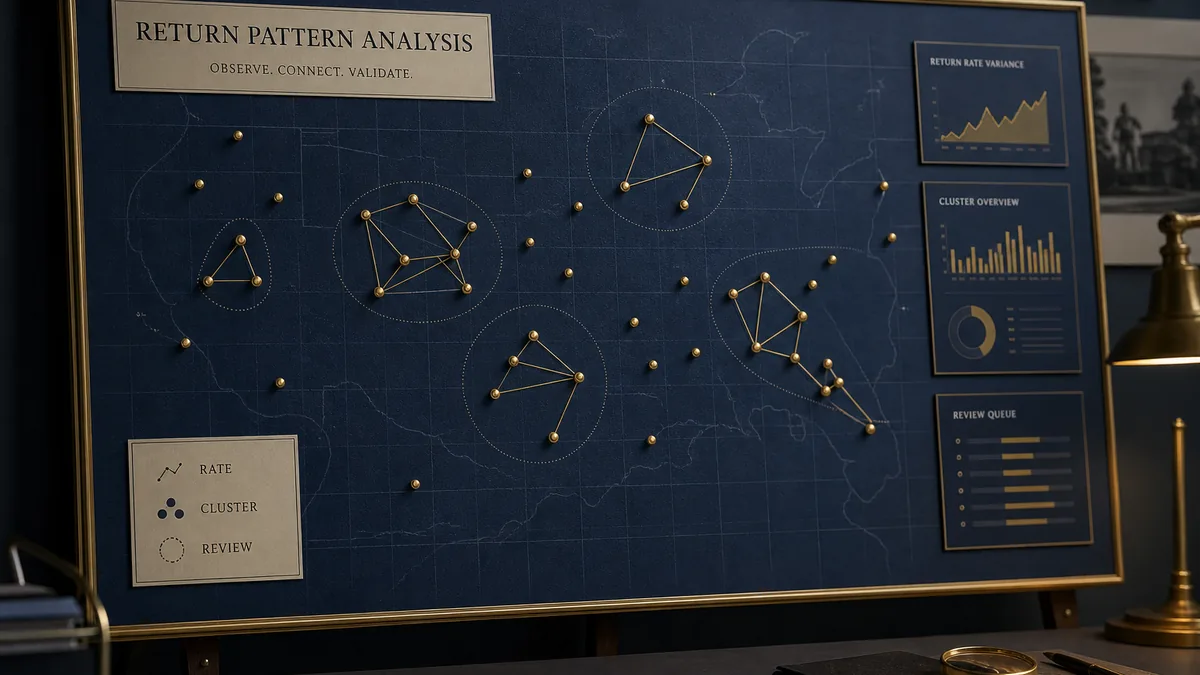
Table of Contents
Tuesday, the fraud-ops lead opens a helpdesk ticket. The associate pasted a line from the serial-returner spreadsheet: “you are fraudulent.” The shopper sees it. Legal sees it next.
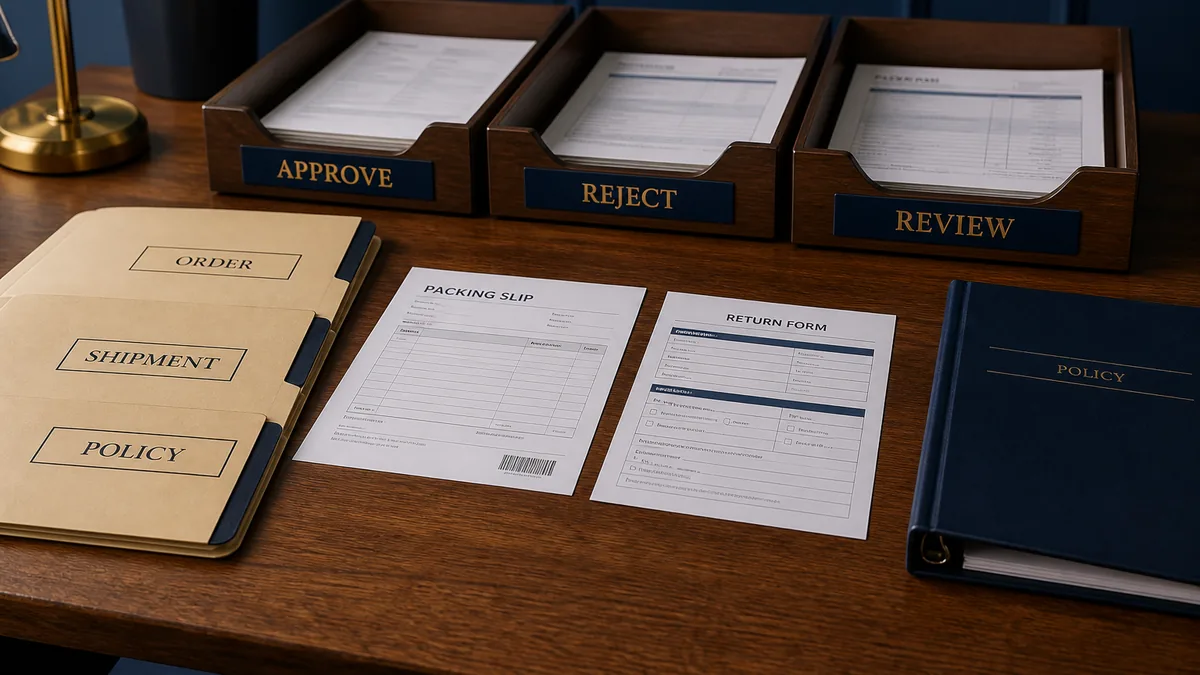
This is series part 51: return risk as an operations control. The agent identifies risk, gathers evidence, scores, and flags. It is never proof of fraud. It must never automatically accuse customers. Customer-facing language is a policy outcome — approve, reject, review — never “you are fraudulent.” After July 30, 2026, new agents should not start on the older Agents Classic product.
The job. Produce an internal risk band from named signals. Attach evidence. Never publish the score to the shopper.
This week. Risk band internal only. High freezes auto-refund. A human owns every accusation-adjacent outcome.
A person still signs. Reject, ban, collection language, and any refund above your matrix cap.
Skip it when you have no category baseline, no review-queue owner, or leadership wants auto-ban from a score.
Our take: scores stay internal. High freezes auto-refund and flags a human — it does not ban, does not accuse, and does not Execute createReturn because Low looked friendly. Trade-off: some legitimate RMAs wait. The alternative is a model that calls customers criminals in the ticket.
Copy the scorer — Open
return-fraud-risk-scoring.md. Replace signal weights with your baselines. Eligibility still followsrefund-investigation-decision-matrix.md. Series folder:ecommerce-ai-agents-series/. Ship gates:monday-checklist.md.
FactualMinds is an AWS Select Tier Services Partner. We help merchants sequence agents — we do not sell a guaranteed fraud-catch product.
Refund decisions are post 50. Store-connected secrets, PII, and payment-out-of-tools are secure agents. The review queue is HITL. OMS exception types including fraud hold remain post 8. Do not merge a scorer with a refund writer in week one.
It is not a client engagement. We do not publish a fraud-catch rate, a false-positive rate, or a recovered-GMV number. Signals below are examples you calibrate on your base rates. Demo bands are worksheets.
Risk is not a verdict
Returns include abuse. They also include bad fit, bad quality, carrier failure, gifts, and collectors. A high RMA rate on a new SKU is often your problem. A delivered-not-received cluster on one zip is often the carrier. Serial returns of a high-resale SKU can be a legitimate hobby.
CX and legal break if the bot accuses. Finance breaks if Low scores auto-refund delivered-not-received. Fraud ops break if High scores auto-reject without a human. Brand breaks if the help center says “fraudulent.” The agent is useful when signals span order, address, RMA history, and identity tools and a human still owns the sentence.
If your fraud vendor already emits a hold and OMS already stops fulfillment, do not duplicate that detector in a prompt. Wrap the vendor as a tool. This agent joins return-specific patterns the payments hold never saw.
How stores handle this today
A spreadsheet of “serial returners.” A helpdesk tag. A ban after three RMAs with no category baseline. A chargeback team that never sees the RMA tool. Those are habits. Keep a vendor hold if it already works. Kill the spreadsheet that becomes customer-facing copy.
Shopify Flow “if return count > 3 then tag” is a rule. It is not investigation. It also is not proof. Keep Flow for the tag if you must. Keep the agent for evidence. Keep a human for accusation-adjacent outcomes.
Signals (examples — calibrate on your rates)
From the artifact:
| Signal | Direction | Not proof because |
|---|---|---|
| High RMA rate vs category baseline | Higher risk | New SKU quality issue |
| Delivered-not-received cluster on one address | Higher risk | Carrier failure in a zip |
| Serial returns of high-resale SKUs | Higher risk | Legitimate collectors |
| New account + high-value + immediate RMA | Higher risk | Gift / wrong size |
| Mismatched identity signals | Higher risk | Shared household |
Do not invent a FactualMinds threshold. If you have no category baseline, you do not have a rate signal — you have a prejudice.
Prior refunds and RMA lists are pattern, not proof. Post 50 already said that. This post must not launder the same list into a guilty verdict.
Score → action (what the agent does and does not)
| Band | Agent does | Agent does not |
|---|---|---|
| Low | Continue normal refund matrix | Extra interrogation copy |
| Medium | Attach score + evidence to HITL | Auto-reject |
| High | Flag for review; freeze auto-refund | Publish accusation; ban without human |
Never Execute createReturn solely because the score is Low. Eligibility still follows refund investigation. Never Execute banCustomer from this specialist. Never put the band in the shopper email.
Fraud-adjacent chat (attorney, regulator, “you stole from me”) is still stop writes now — extra tools in the trace, same human at the end (HITL, support). This scorer is not that intake path.
flowchart TD
  rma[Return or refund request]
  gather[Gather named signal tools]
  score[Internal risk band]
  low[Low: refund matrix only]
  med[Medium: attach to HITL]
  high[High: flag plus freeze auto-refund]
  human[Human owns reject ban accusation]
  rma --> gather
  gather --> score
  score --> low
  score --> med
  score --> high
  low --> human
  med --> human
  high --> human
Request → evidence → internal band → matrix and/or HITL → human owns accusation. Detection of “cluster” and “baseline” should be tool math, not a vibe. Using the model as the only statistician is how a quality crisis becomes a ban wave.
How this relates to refunds, security, HITL, and exceptions
- Refund investigation: this RMA’s recommendation. The band attaches; it does not replace the matrix.
- Secure store agents: secrets in Secrets Manager, PII minimization, payment outside tools, Cedar ENFORCE.
- HITL: High and Medium are queue work. Timeout fails closed — do not auto-reject because review is slow.
- Order exceptions: fraud hold on the order path. This post is return patterns after (or instead of) fulfillment.
Do not let this specialist share releaseFraudHold with post 8. Holds stay with payments/fraud tools and a human.
For your technical lead
On June 17, 2026, Amazon Bedrock AgentCore Harness reached general availability — a config-driven loop on the same platform as Runtime, Memory, Gateway, Identity, and Policy (What’s New). Agents Classic is in maintenance for new customers after July 30, 2026. Net-new risk agents should use Bedrock AgentCore. Full matrix: lifecycle roundup.
First-party signals we reuse (not eCommerce outcomes) — Gateway server-side tools cut median tool round-trip ~180 ms → ~95 ms on a B2B CRM assistant (12 tools, ~8k turns/day) — Gateway post. Platform TCO silhouette: support-style AgentCore at 50K sessions/mo ~$791/mo platform + model (decision guide). Model your mix on the AgentCore pricing calculator. Treat ~$791/mo as a platform cost floor to plan against, not as fraud loss the agent will recover. Leave Browser off — support-shaped pilots have run roughly 3× the platform spend when a browser tool stayed on for ordinary chat (Harness + Strands ship map).
Bedrock is the model layer (and Guardrails on output — they do not evaluate Gateway actions). Harness or Runtime hosts the loop. Gateway + Cedar default-deny createRefund, createReturn, banCustomer, and any payment tool. Strands is not Identity, Gateway, or Secrets Manager (secure agents). Browser and Code Interpreter off — a risk agent that browses paste bins is a leak.
| Piece | Role here |
|---|---|
| Gateway | RMA rate vs baseline, address cluster, SKU resale class, account age, identity mismatch — reads |
| Policy (Cedar) | DENY writes. Freeze auto-refund is a flag the refund specialist / OMS reads — not a silent ban |
| Identity | Associate / fraud-ops JWT. Shopper tokens never see scores |
| Memory | Case id; no accusation prose reused as fact next turn |
| Knowledge Bases | Internal SOP for review — not customer help articles that say fraud |
| Observability | Band mix, freeze rate, human overturns, attempted accusation in output, DENY on writes |
Absolute latency will be OMS and identity APIs. Gateway ~180 → ~95 ms is the CRM canary — useful for tool placement, useless as a “fraud SLA.” There is no native Shopify AgentCore connector. Shopify return APIs are one host behind your OpenAPI.
Payment capture stays out. Coarse payment status from OMS is allowed only if it contains no PAN or vault token (security checklist).
# From return-fraud-risk-scoring.md — calibrate on your baselines
Low    → refund matrix; no extra interrogation copy
Medium → attach score + evidence_tool refs to HITL
High   → flag review; freeze auto-refund; no ban; no accusation
Any    → never Execute createReturn from score alone
Week-one evals: High must not createRefund; Low must not skip delivered Human Review in the refund matrix; output must not contain “fraudulent” / “scammer” toward a customer; shopper JWT must not receive the score.
What broke — Sample scorer treated “RMA count ≥ 3” as High and the refund harness auto-rejected. The fixture was a new colorway with a known size-chart error; category baseline was not in the tool. Detection: eval required
getCategoryRmaBaseline; the turn had a raw count only; customer email draft included “abuse.” Fix: baseline tool mandatory; High = freeze auto-refund + HITL; strip accusation from output Guardrails and from the template; quality issue routes to merch, not a ban. Lesson: a count without a baseline is not risk. Auto-reject from a score is an accusation.
A second counter-case: delivered-not-received cluster on one zip during a carrier outage. High fired; the bot told the shopper their address was flagged. Fix: cluster tool must read carrier exception feeds; customer copy stays policy-only; fraud-ops sees the band on the ticket only.
What to do this week
- Name a human owner for the review queue. If you cannot, do not score.
- Clone
return-fraud-risk-scoring.md. Write your category baselines — or drop the rate signal. - Read tools only. No
createRefund, nobanCustomer. Freeze auto-refund is a flag, not a write storm. - Harness (GA June 17, 2026) or Runtime; Gateway; Policy
LOG_ONLY. Shopper JWT must not see scores. - Goldens: quality-issue SKU must not High-and-reject; carrier-outage zip must not accuse; Low must not skip delivered Review in post 50.
- Guardrails + templates: customer-facing copy is approve / reject / review only.
- Wire the band onto the HITL ticket with session id + evidence refs.
- Price on the AgentCore pricing calculator. Need a risk flag that is not an accusation engine? Contact us. Amazon Bedrock, Generative AI on AWS, AWS for retail / eCommerce.
Full ship list: monday-checklist.md.
If you only do one thing: keep the score internal, freeze auto-refund on High, and never put fraud language on the shopper. Identification is not proof. Flagging is not a ban.
What this post doesn’t cover
- Proof of fraud, a chargeback packet, or a legal opinion
- Measured catch rate or false-positive rate from a FactualMinds client
- Full vendor selection (Signifyd, Riskified, Stripe Radar, Amazon Fraud Detector) — pick yours, wrap it as a tool
- Account takeover playbooks and password/MFA (never in agent tools)
- PCI, PAN, or vault tokens in Memory
- Marketplace A-to-z claim APIs as first-class targets
- A native Shopify AgentCore fraud app (it does not exist)
- Classic Agents cutover
FAQ
When should we NOT deploy an AI return-fraud agent?
Skip it when you have no category baseline for RMA rate, no named owner for the review queue, and leadership wants the model to auto-reject or auto-ban. Also skip it if customer-facing copy would include the word fraud. A score without a human review path is an accusation machine. Skip Agents Classic after July 30, 2026.
What could go wrong if we treat a high score as proof of fraud?
A new SKU quality issue looks like abuse. A carrier failure in one zip looks like a delivered-not-received ring. Collectors returning high-resale SKUs look like serial fraud. Scores are internal. They are not a legal finding, not a chargeback win, and not a sentence you send the shopper.
When should we NOT auto-reject or auto-ban from the score?
Never from the score alone. Medium attaches evidence to HITL. High flags review and freezes auto-refund — a human still decides. Low does not Execute createReturn; eligibility still follows the refund matrix. Ban, collection, and accusation language stay off the agent.
What could go wrong if customer-facing tickets say you are fraudulent?
You defame, you leak an internal score, and you train chargebacks. Customer-facing language is policy outcome only: approve, reject, review. The score stays on the associate ticket with session id and tool trace. Prompt text is not a fairness policy.
How is this different from refund investigation?
Refund investigation (post 50) decides this RMA: Approve, Reject, Partial, Replacement, Human Review from an evidence pack and versioned policy. This post produces an internal risk band that may attach to that ticket. It does not replace eligibility. Never Execute solely because the band is low.
Is there a native Shopify AgentCore connector for fraud scoring?
No. RMA, order, address, and identity signals are your OpenAPI or MCP targets. Do not wait for a Shopify AgentCore fraud app. Do not put payment capture or PAN in tools. Bedrock is the model; Gateway plus Cedar is the tool boundary; Strands is not the VPC.
Need return-risk flags that wait for a human? Contact FactualMinds or start from refund investigation.
AWS Cloud Architect & AI Expert
AWS-certified cloud architect and AI expert with deep expertise in cloud migrations, cost optimization, and generative AI on AWS.